
India’s Clean Energy Ambition: A Before–After–Bridge Perspective
- Jitisha Hiremath
- Apr 10
- 3 min read

India has set an ambitious goal to transform its energy landscape by 2035. The country aims to generate 60 percent of its installed electric power capacity from non-fossil fuel sources. This target is part of India’s formal climate commitments under the Paris Agreement, which also include reducing the emissions intensity of its GDP by 47 percent from 2005 levels and creating a carbon sink of 3.5 to 4 billion tonnes of CO2 equivalent through forest and tree cover. These goals reflect India’s commitment to sustainable development and global climate action.

Before: A Growing Nation, A Strained Energy Reality
India stands at a critical crossroads. As one of the world’s fastest-growing economies, its energy demand is rising rapidly, driven by urbanisation, population growth, and industrial expansion. Yet, this growth has long been powered by coal and other fossil fuels.
The consequences are visible:
Rising greenhouse gas emissions
Severe air pollution affecting public health
Heavy dependence on energy imports
This creates a fundamental imbalance development sustained by an energy system that is neither environmentally sustainable nor economically secure in the long run.
After: The India of 2035
Now imagine an India where 60% of installed electric power capacity comes from non-fossil fuel sources.
Cities with cleaner air and healthier populations
A diversified energy mix ensuring energy security
Millions of jobs in renewable energy sectors
A nation leading global climate action
Aligned with its commitments under the Paris Agreement, India aims to:
Reduce emissions intensity of GDP by 47% from 2005 levels
Create a carbon sink of 3.5 to 4 billion tonnes of CO₂ equivalent
Transition towards sustainable and inclusive growth
This is not just an energy shift it is a transformation of India’s development model.
Bridge: How India is Getting There
India’s strategy is both ambitious and multi-layered.
1. Expanding Non-Fossil Energy Sources
India is rapidly scaling:
Solar Energy through initiatives like the National Solar Mission
Wind Energy across states like Tamil Nadu and Gujarat
Hydropower leveraging Himalayan potential
Nuclear Energy as a stable, low-carbon base
Together, these form the backbone of the 60% target.
2. Policy Push and Structural Reforms
Renewable energy auctions reducing costs
Energy efficiency programs like PAT
Electric mobility initiatives reducing fossil fuel demand
Afforestation drives strengthening carbon sinks
3. Real Progress on Ground
India has already achieved around 40% non-fossil installed capacity, with rapid additions in solar and wind.
Flagship examples include:
Rewa Ultra Mega Solar Park (Madhya Pradesh)
Large-scale wind farms in Gujarat
National Electric Mobility Mission
These demonstrate that the transition is not theoretical—it is already underway.
4. Challenges That Must Be Solved
Despite progress, key hurdles remain:
Grid integration and storage for renewable variability
Financing large-scale infrastructure
Land acquisition complexities
Need for improved energy efficiency
Addressing these will require coordinated action between government, industry, and communities.
What This Transition Means
India’s clean energy ambition is not just about climate, it is about:
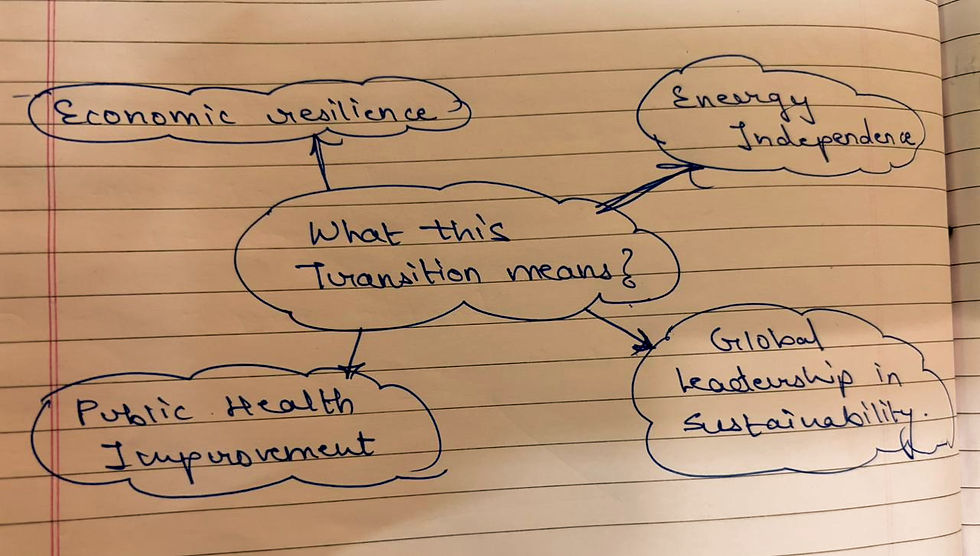
It reflects a shift from survival-driven growth to future-ready development.
Way Forward
India’s journey from a fossil-fuel-dependent present to a clean energy future is both necessary and inevitable. The goal of 60% non-fossil fuel power capacity by 2035 is not just a policy target, it is a statement of intent.
The journey will require continued innovation, investment, and policy support.
वीर भोग्या वसुंधरा (Veer Bhogya Vasundhara) the Earth is inherited by the brave.
India’s clean energy transition is choosing sustainability today and having a secure tomorrow.


Nicely written, amazing research about "ENERGY" - which everyone fights for. It's great to see government new initiatives including the new fast breeder reactor. We should also focus on more privatization of sectors like energy, which will allow rapid improvement in innovation and optimize energy management for households (ultimately we are the one's making use of it) and hopefully this solves energy conflicts too.!! Thanks
It's detailed and quite informative for people who are not in the field